Building the bridge towards 360° safety, meaningful connection, active participation and a life that feels like your own.
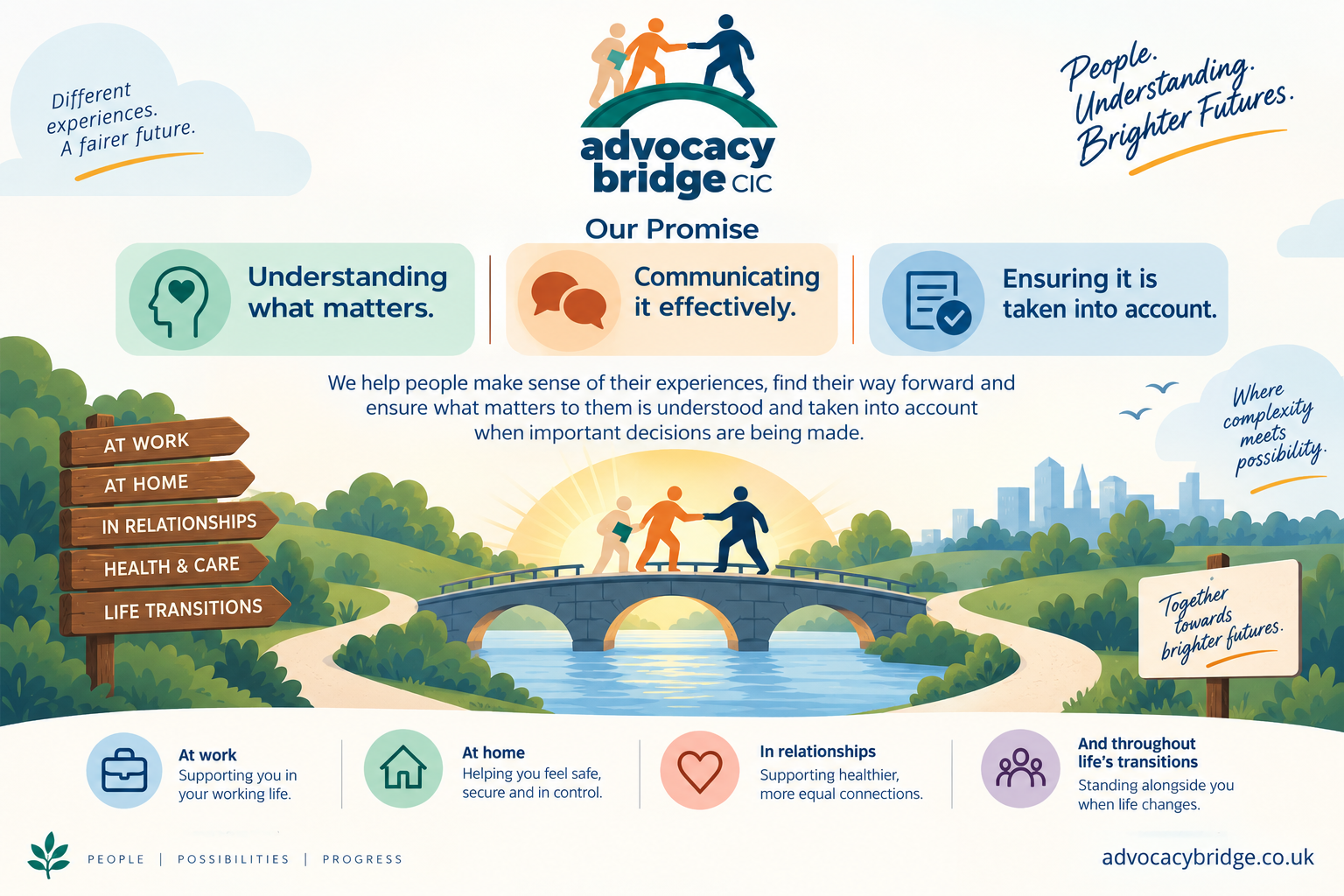
The Advocacy Bridge Promise
Understand what matters. Communicate it effectively. Ensure it is taken into account.
When life, work, business or systems become overwhelming, unsafe or difficult to navigate, we help you understand what’s happening, communicate what matters and participate in what comes next.
We work alongside people who feel stuck, unheard or have fallen through the gaps — protecting autonomy, strengthening voice and helping build the right scaffolding of people, services and support around them.
OVERWHELMED → someone helps me hold this → UNDERSTANDING → I can see what's happening → SUPPORTED → I can participate with someone beside me → SELF-TRUST → I trust my interpretation and decisions again → INTERDEPENDENCE → I know what I can do, what I need help with, and who should provide that help.
This isn't a linear journey. The amount and type of support someone needs can change over time.
Where there are concerns about safety or someone's ability to navigate what is happening, we may work more closely alongside them and the people or services involved. As safety, connection and support strengthen, our role changes too:
Stepping in → Standing alongside → Stepping back
Individuals
Be heard, understood and meaningfully involved in decisions about your life, work, business and future at a pace that works for your brain, body, heart and mind.
Organisations
Better understand people, remove barriers and improve engagement, participation and outcomes.
Good advocacy doesn't make itself indispensable. It helps people and systems understand each other well enough for something to change.
Advocacy Bridge is the bridge — not the destination.
What We Help People Achieve
PERSON → understands themselves and communicates what matters
SYSTEM → better understands the person and what may be getting in the way.
People arrive when they need help understanding something that is happening, navigating it or participating in what happens next.
Advocacy Bridge helps individuals make sense of themselves, their experiences, their circumstances and their options, so they can make informed decisions and have a meaningful voice in what happens next.
We also help organisations and professionals better understand people's experiences, needs and the barriers affecting communication, engagement, participation and outcomes.
Whole Person Approach
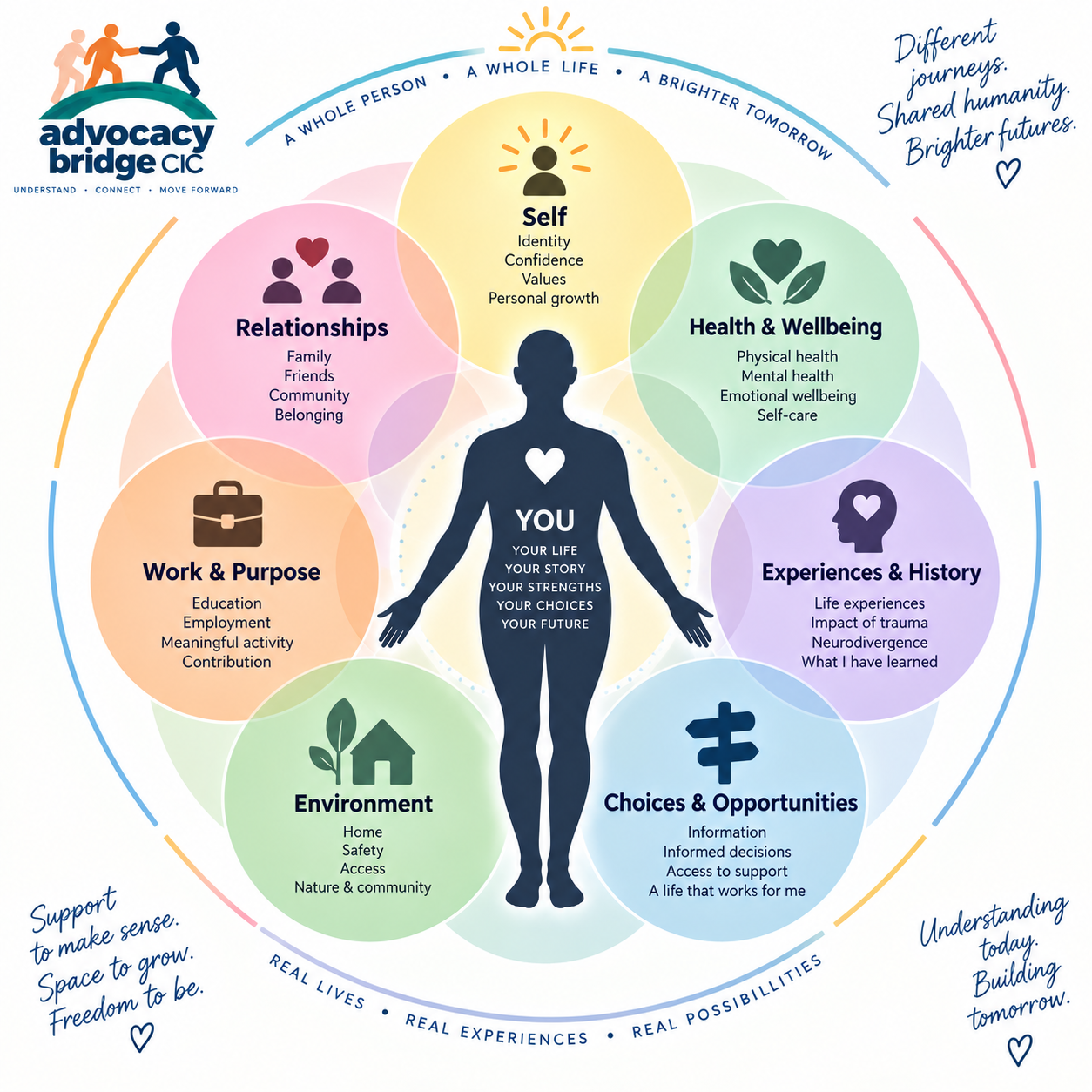
Many challenges do not exist in isolation. Difficulties at work can affect health. Health can affect relationships. Trauma can affect communication. Systems can overlook how different aspects of a person's life interact with one another.
Advocacy Bridge looks at the whole person and their life, not just one problem, diagnosis, service or situation.
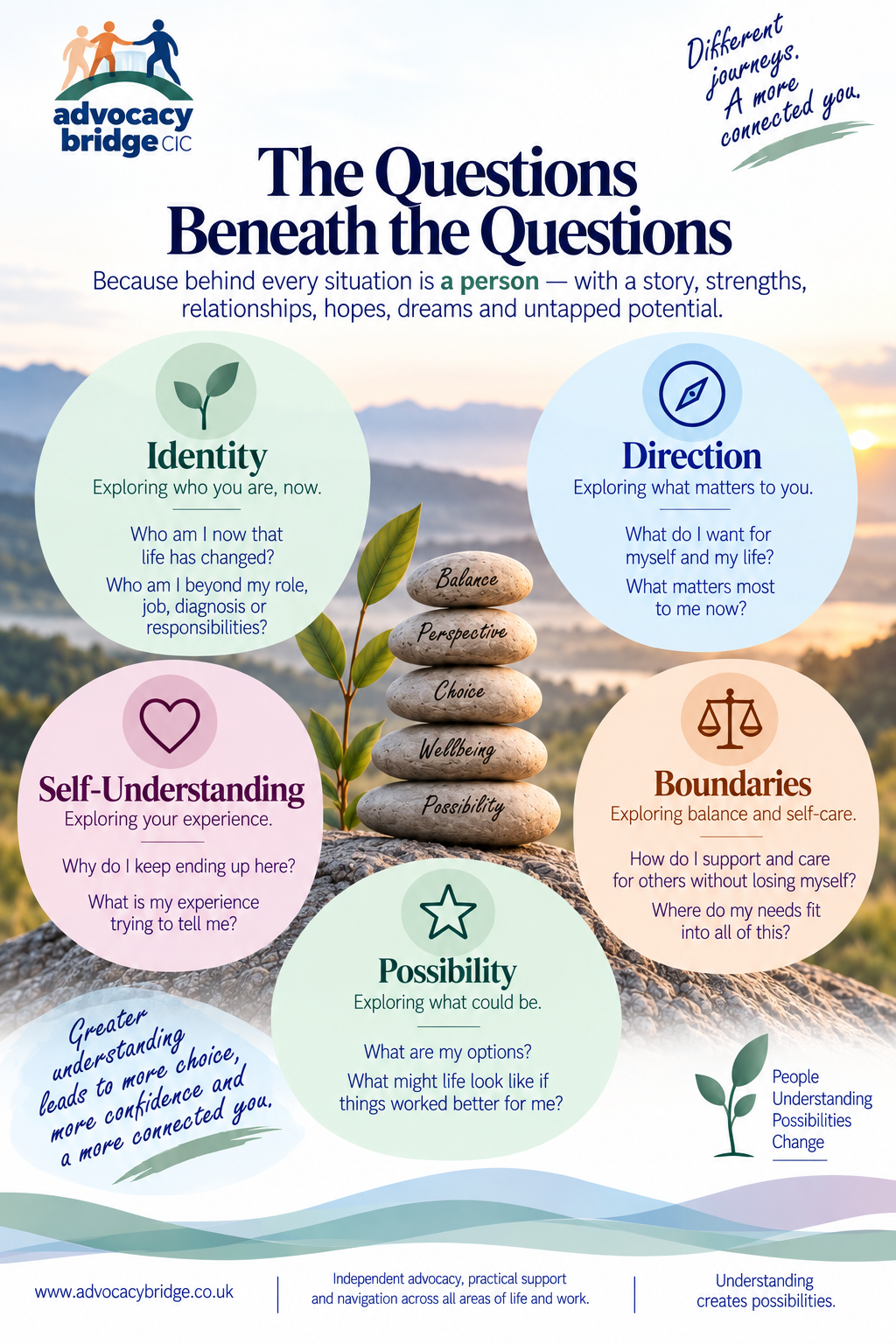
By taking a whole-person approach, we help people make sense of themselves, their experiences, their world, their options and what matters most to them.
We create the conditions for understanding, clarity and meaningful participation. Together, we help people recognise their strengths and limitations, communicate their needs, make informed choices, establish healthy boundaries, access appropriate support and participate more meaningfully in decisions about their lives.
How We Work
We take time to understand what life is like from the client's perspective.
This often involves exploring experiences, patterns, barriers, strengths, relationships, environments and the wider systems affecting their lives.
We don't tell people what matters to them. We help them discover, understand and communicate it.
We help people make sense of their experiences, articulate what matters most and translate complex realities into information that professionals, organisations and services can understand and work with.
Where appropriate, we help identify the right expertise, prepare people for productive conversations, facilitate communication and ensure relevant evidence, insights and recommendations are considered within decision-making processes.
Our aim is to create greater understanding between people, professionals and systems so that better-informed decisions and more sustainable outcomes become possible.
Together We Can Help...
Plan • Take Action • Be Heard • Move Forward
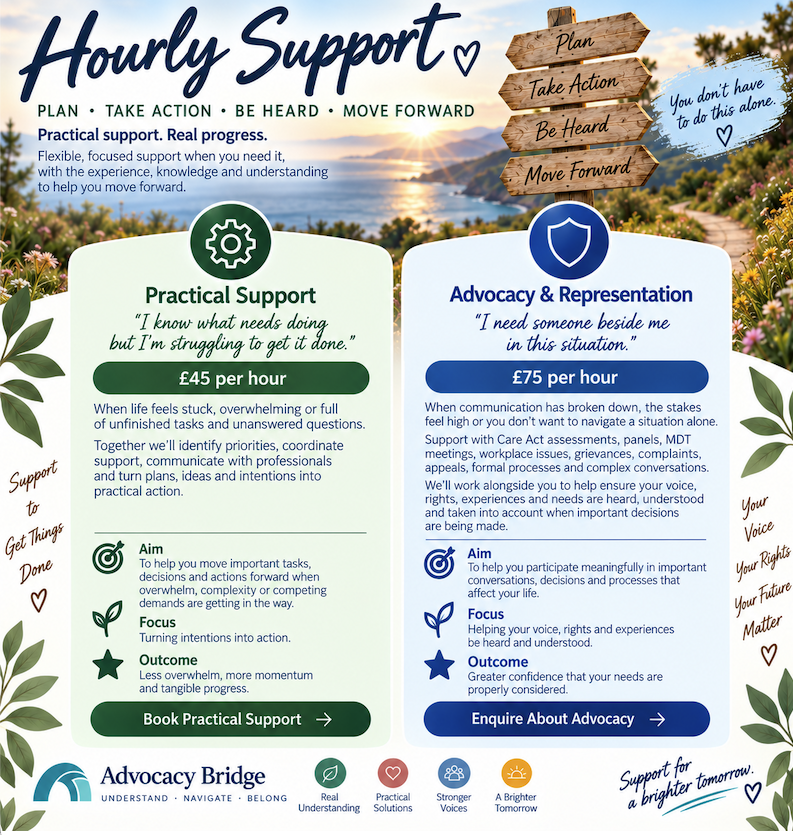
Hourly Support
Practical Support
Advocacy & Representation
For people needing focused support with implementation, systems, communication and formal processes.
We help people understand what matters to them, communicate it effectively and ensure it is taken into account when important decisions are being made.
Practical & Advocacy Support
£45 per hour
When you need help to work out what needs to happen, communicate what you need and get things moving.
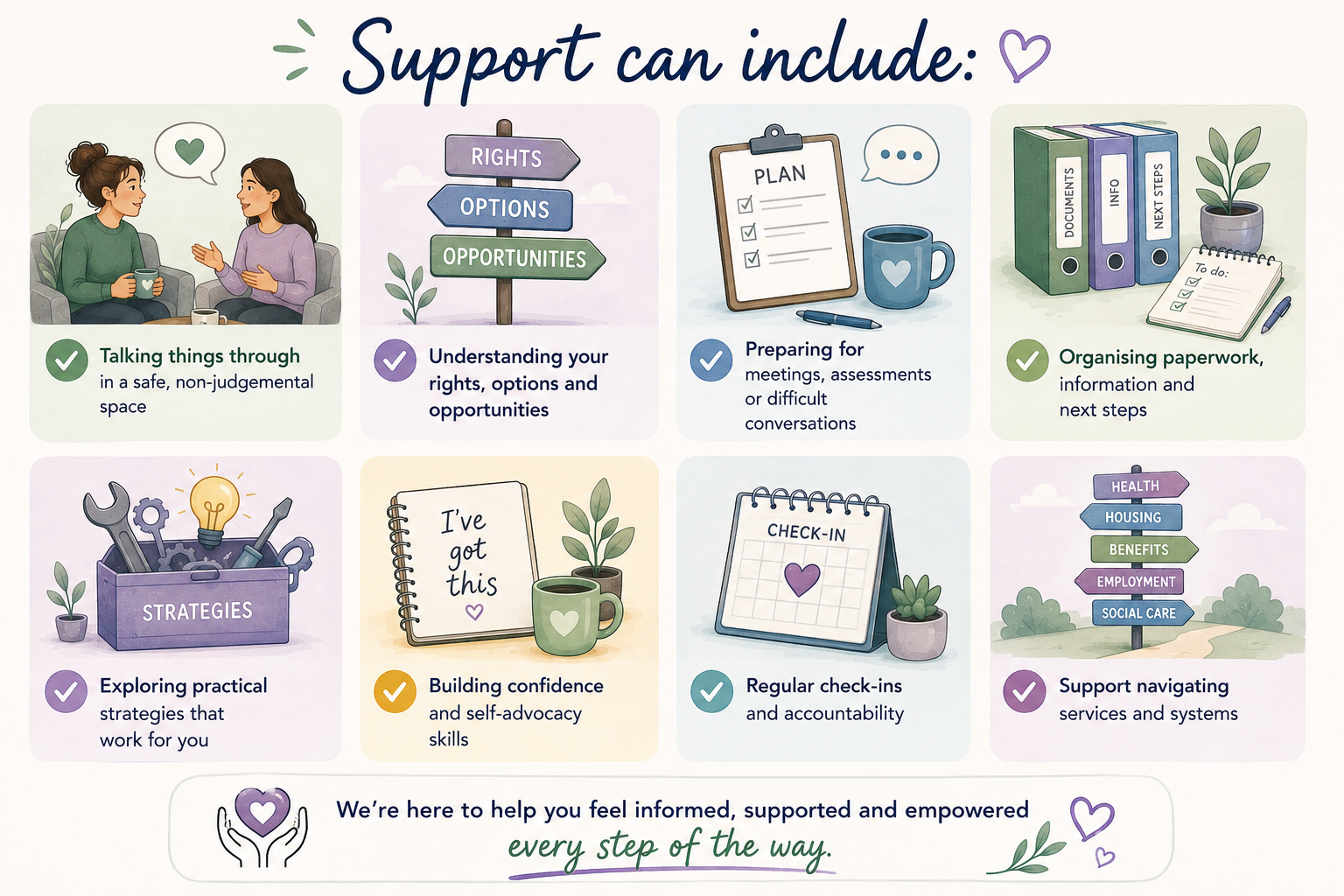
We can think things through with you, identify priorities, understand options, navigate services, prepare for conversations, communicate with professionals and turn plans and intentions into practical action.
This can include helping you to understand, prepare, organise, communicate and advocate for yourself — without taking over.
Aim: To help you work out what you need and move important tasks, conversations, decisions and actions forward.
Focus: Clarity, communication and practical action.
Outcome: Less overwhelm, clearer next steps and tangible progress.
“Help me work out what I need, what to say and what to do next.”
Advocacy & Representation
£75 per hour
When you need someone to actively advocate alongside you or represent your voice with other people or organisations.
This can include attending Care Act assessments, panels, MDT meetings and other professional meetings, and supporting you through workplace issues, grievances, complaints, appeals, formal processes and complex or high-stakes conversations.
We will work with you beforehand to understand what matters to you, what you want to communicate and what outcome you are seeking, so that we can accurately advocate for your wishes, experiences, rights and needs.
We can attend alongside you, support you to participate, speak when you want us to, ask questions, seek clarification and — where agreed — communicate or represent your views on your behalf.
Aim: To help ensure your voice is heard and you can participate meaningfully in important conversations, decisions and processes.
Focus: Active advocacy, participation and representation.
Outcome: Your views, wishes, needs and experiences are clearly communicated and properly considered.
“I need someone beside me to help make sure my voice is heard.”
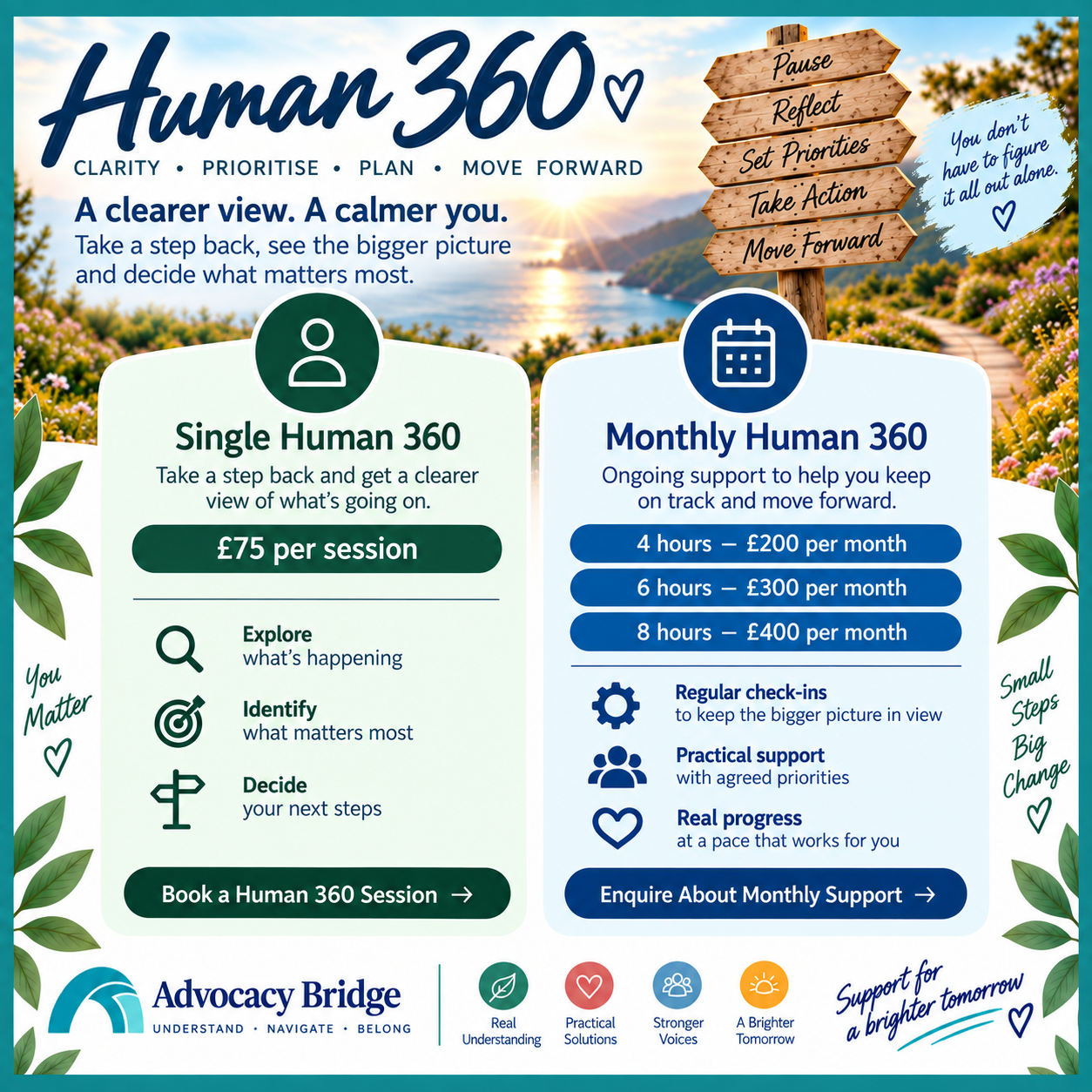
Human 360 — Your Way
Choose your level of support
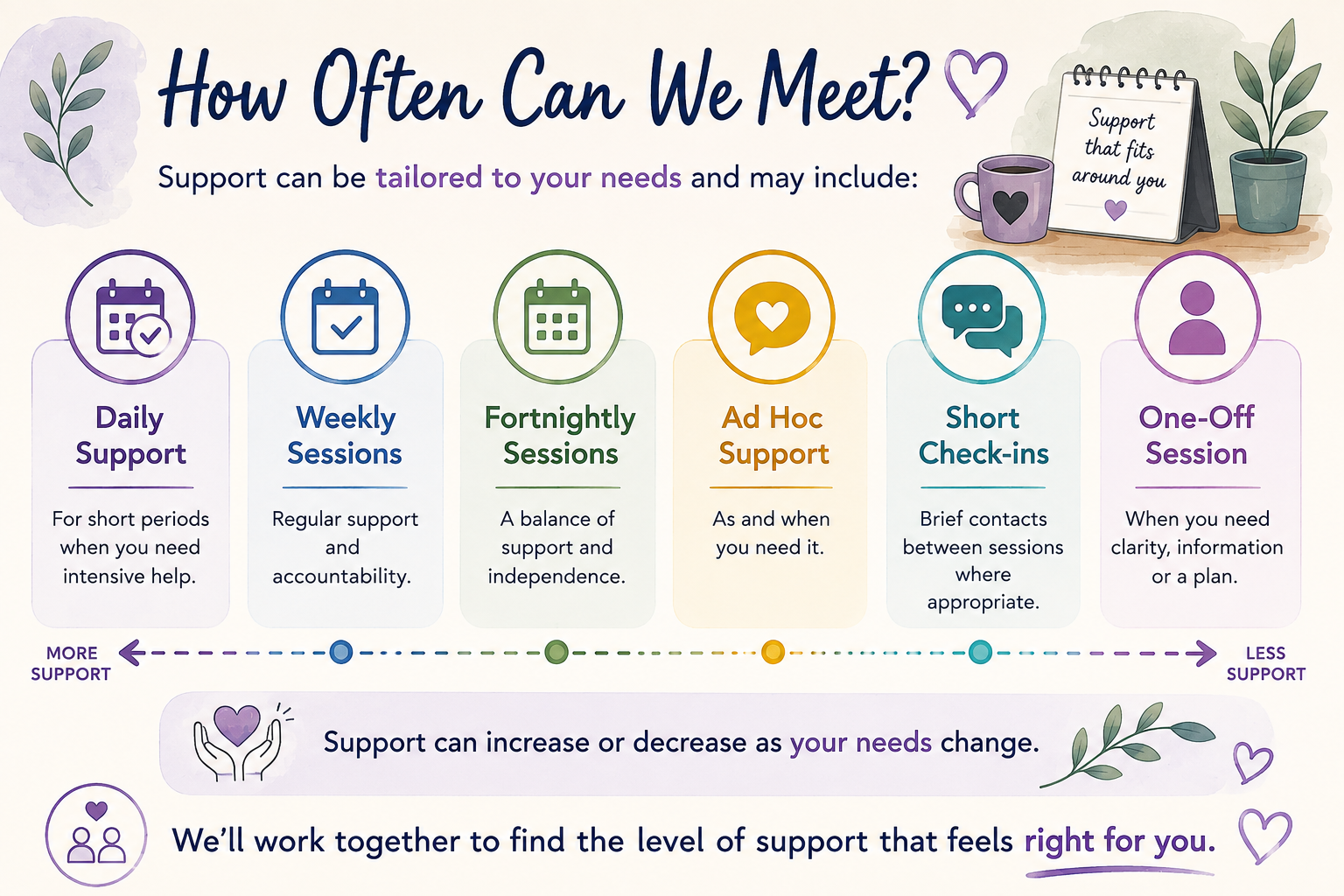
Single / Adhoc — Where am I now? Monthly — Help me keep things moving. Quarterly — Let's step back and recalibrate. Annual — Let's take stock of my year and what's next.
Human 360
£75 single session | Monthly, Quarterly & Annual Support
When there isn't just one thing going on.
Human 360 gives you space to step back and look at the whole picture — what's happening across your life, what's working, what's becoming difficult, what you're carrying and what needs attention.
Together, we'll untangle what's going on, identify priorities and work out where your time, energy and available support could make the biggest difference.
You can book a single Human 360 session for £65, or choose ongoing support if you'd benefit from regular check-ins, continuity and practical help moving things forward.
Aim: To help you understand the bigger picture and identify what needs attention.
Focus: Your whole life — priorities, pressures, capacity, support and what matters to you.
Outcome: Greater clarity, clearer priorities and a realistic way forward.
"There's so much going on that I don't know what needs my attention first."
Single Human 360
£75 per session
A dedicated opportunity to step back, take stock and work out what needs your attention now.
Human 360 Monthly
£200–£250/month Ongoing weekly support, normally 4–5 sessions per month, charged at £50 per session.
We'll use your allocated time together around agreed priorities, which may include Human 360 check-ins, practical support, planning, communication, coordination and follow-through.
Use your Human 360 to look at what's changed, what's working, what has become stuck and what you want to focus on next.
Human 360 provides an agreed amount of support rather than unlimited or on-demand access. Any additional support is agreed separately and subject to availability.
Workplace Advocacy & Employment Support:
Having rights at work and being able to use them are two different things.
When you're overwhelmed, unwell, neurodivergent, disabled, facing redundancy or struggling at work, understanding your rights is often only part of the picture.
You may also need help understanding what's happening, what your options are and what you want to do next.
Advocacy Bridge can help you:
understand workplace information and correspondence
prepare for meetings, reviews, grievances and difficult conversations
communicate your needs and concerns
explore reasonable adjustments and support
keep track of decisions, actions and next steps
identify and access specialist employment support where appropriate
You don't need to become an employment-law expert to advocate for yourself.
Our role is to help you move from:
“I don't understand how I got here, what's happening or what to do next.”
to:
“I understand what's happening, I know what matters to me and I know my next step.”
We provide independent advocacy, practical support and navigation — not legal advice or legal representation.
Employment rights are changing
From October 2026, important changes include longer time limits for many Employment Tribunal claims and stronger duties on employers to prevent workplace harassment.
Further employment protections are being introduced during 2027.
If something is happening at work and you're struggling to understand what it means or what to do next, you don't have to work it out alone.
We can help you understand the situation, organise the information, prepare your questions and communicate what you need — while helping you identify when specialist employment or legal advice is required.
Care Act Advocacy & Assessment Support
Understanding your needs and communicating them are two different things.
When you're struggling with daily life, managing health conditions, navigating disability or trying to access support, it can be difficult to understand what help may be available, how decisions are made and what your options are.
You may need help understanding:
how Care Act assessments, reviews and support planning work
what information is important
how your needs affect your daily life
what support may help
what options are available
whether there may be costs involved
what matters most to you
Advocacy Bridge can help you:
prepare for assessments, reviews and support-planning meetings
identify and communicate your needs, wishes and outcomes
understand reports, recommendations and decisions
gather relevant information and evidence
keep track of actions, decisions and next steps
participate more confidently in conversations about your care and support
understand when specialist advice or representation may be needed
You shouldn't have to become an expert in social care to advocate for yourself.
Our role is to help you move from:
"I don't understand what's happening, what my options are or what I want to do next."
"I understand my situation, I'm clear about what matters to me and I'm able to participate meaningfully in decisions about my life.
We provide independent advocacy, practical support and navigation. We do not make decisions on behalf of local authorities or determine eligibility for services.
We can help if...
Work isn't working for you
You're dealing with burnout, workplace difficulties, Access to Work, reasonable adjustments, returning to work or difficult conversations — and need help working out what to do next.
Life has become complicated
You're navigating a major change, health or disability needs, caring or family responsibilities, services or difficult decisions — and need help making sense of everything.
You're struggling to get what you need
You're finding it difficult to explain what's happening, ask for support, deal with professionals or services, or feel heard and understood.
You're discovering you're neurodivergent
You're diagnosed, awaiting assessment or exploring the possibility — and want help understanding what this means for your work, relationships, needs, identity or future.
You don't need to know what service you need or have everything figured out before you contact us.
Tell us what's happening. We'll help you work out what you need and what could happen next.
Something doesn't feel right, but you're not sure what to do next?
Whilst diagnoses, assessments, funding decisions and support services can take months or even years, understanding, self-trust and self-belief don't have to wait.
Many people already hold far more knowledge about themselves than they realise. A diagnosis, assessment or professional opinion may add valuable pieces to the puzzle, but it doesn't replace a lifetime of lived experience.
By developing a better understanding of ourselves, our experiences, our strengths, our challenges, our history and the impact of trauma, we can begin making sense of what is happening, recognise our options and take meaningful steps forward long before formal support arrives.
Are you a professional, organisation or referral partner?
We support adults who are struggling to navigate services, communicate what they need or turn professional recommendations into practical next steps.
Advocacy Bridge can provide practical and advocacy support, independent representation and whole-person support — working alongside the individual and, with their consent, the professionals and services around them.
Refer to us when someone needs more time, coordination or practical support than your service is able to provide.
Working Alongside Existing Services
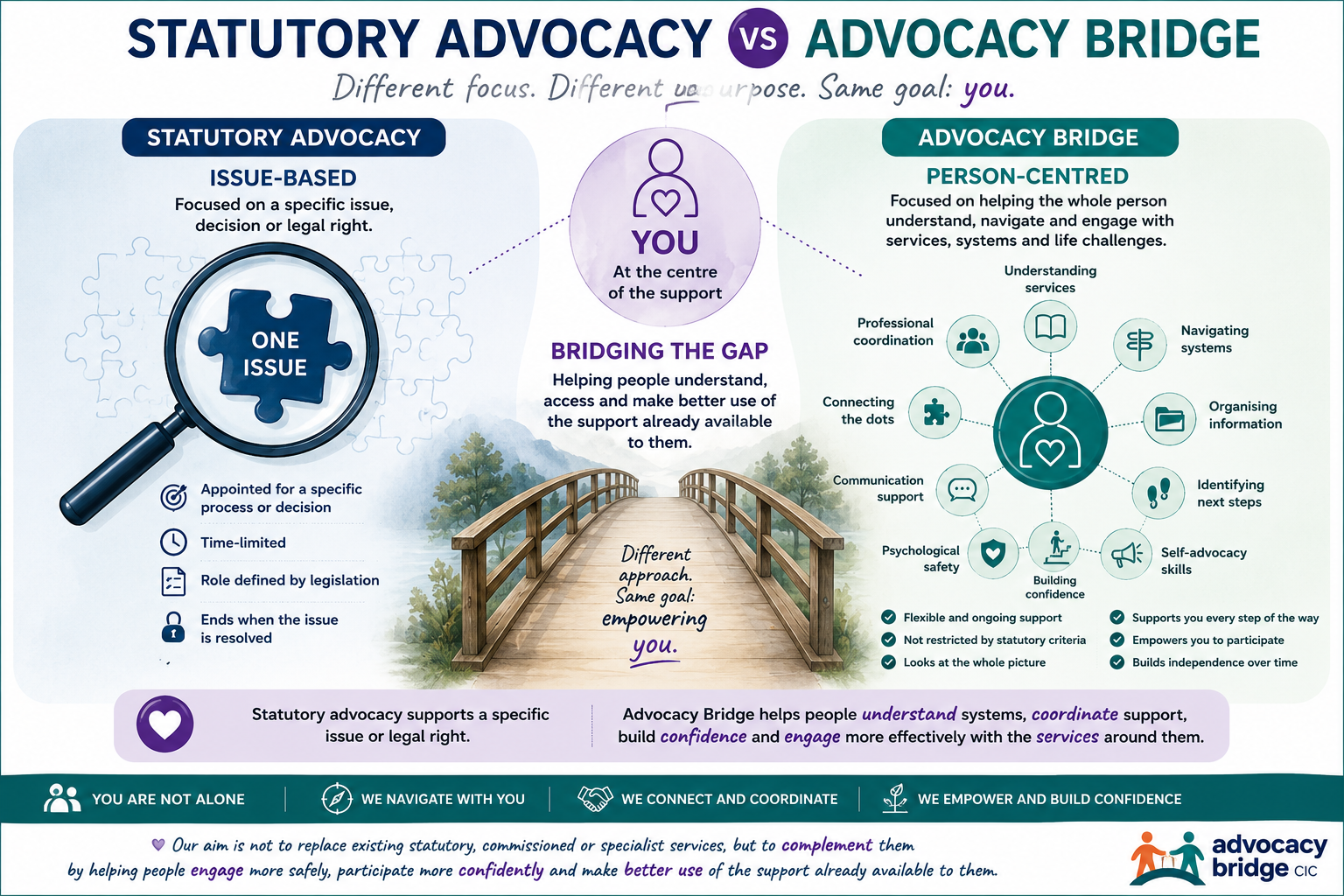
We help bridge the gap between people and the services designed to support them.
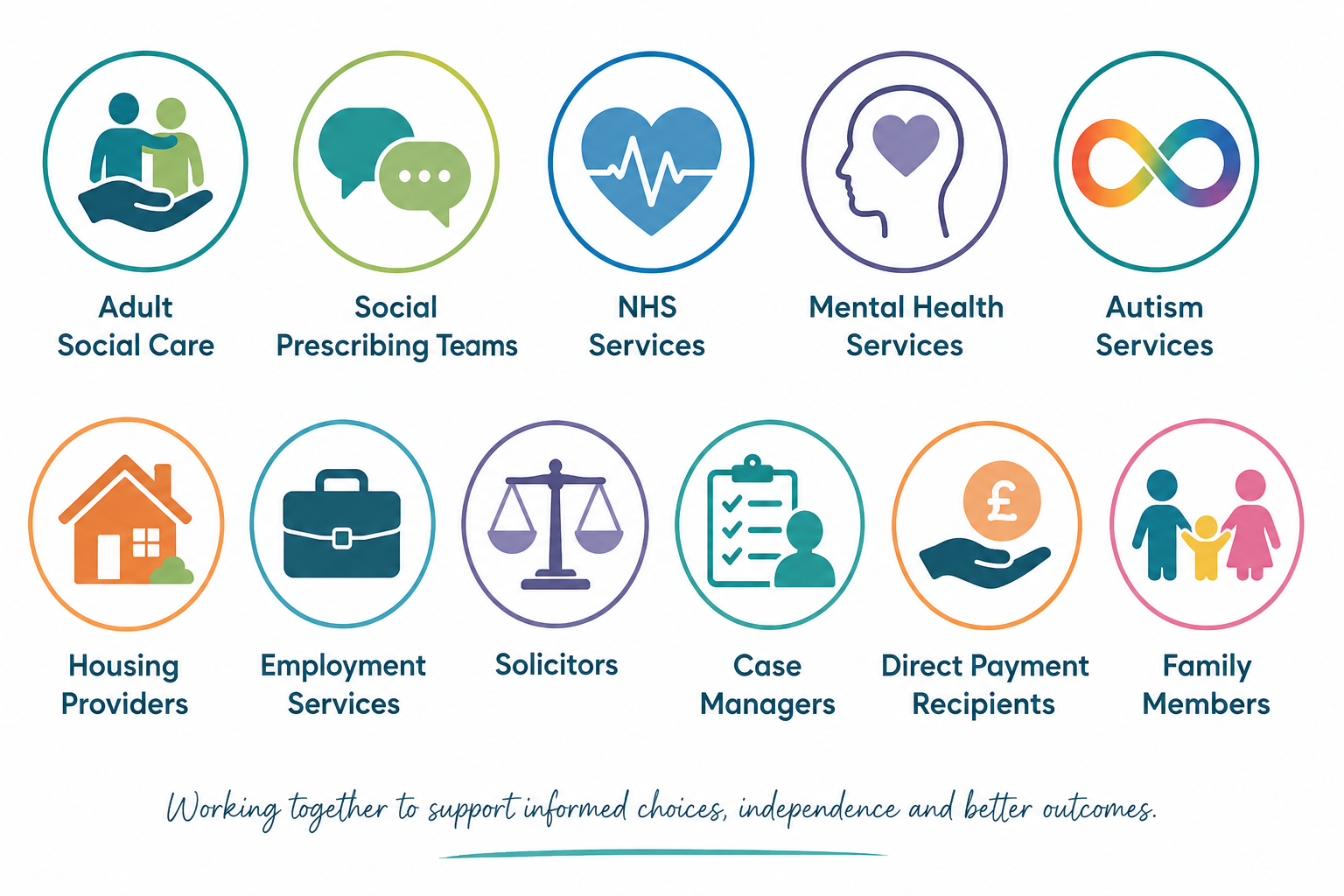
We work alongside statutory, commissioned and specialist services to help people understand what's happening, communicate what they need, navigate processes and turn professional recommendations into practical next steps.
With the person's consent, we can also help professionals understand barriers affecting communication, engagement or access — creating greater shared understanding between everyone involved.
Our support can be particularly valuable when someone is:
falling through gaps between services;
overwhelmed by processes, paperwork or decisions;
struggling to communicate what they need;
finding it difficult to access or engage with support;
dealing with several interconnected issues at once; or
at risk of disengagement or unnecessary escalation.
What we're working towards
clearer understanding of needs, options and next steps;
stronger communication and self-advocacy;
better access to appropriate support;
improved engagement between individuals and professionals;
informed decision-making; and
greater stability, confidence and independence.
We don't replace existing services. We help people navigate, connect with and make better use of the support around them.
Why Advocacy Bridge?
Life doesn't happen in separate boxes — and people's needs rarely do either.
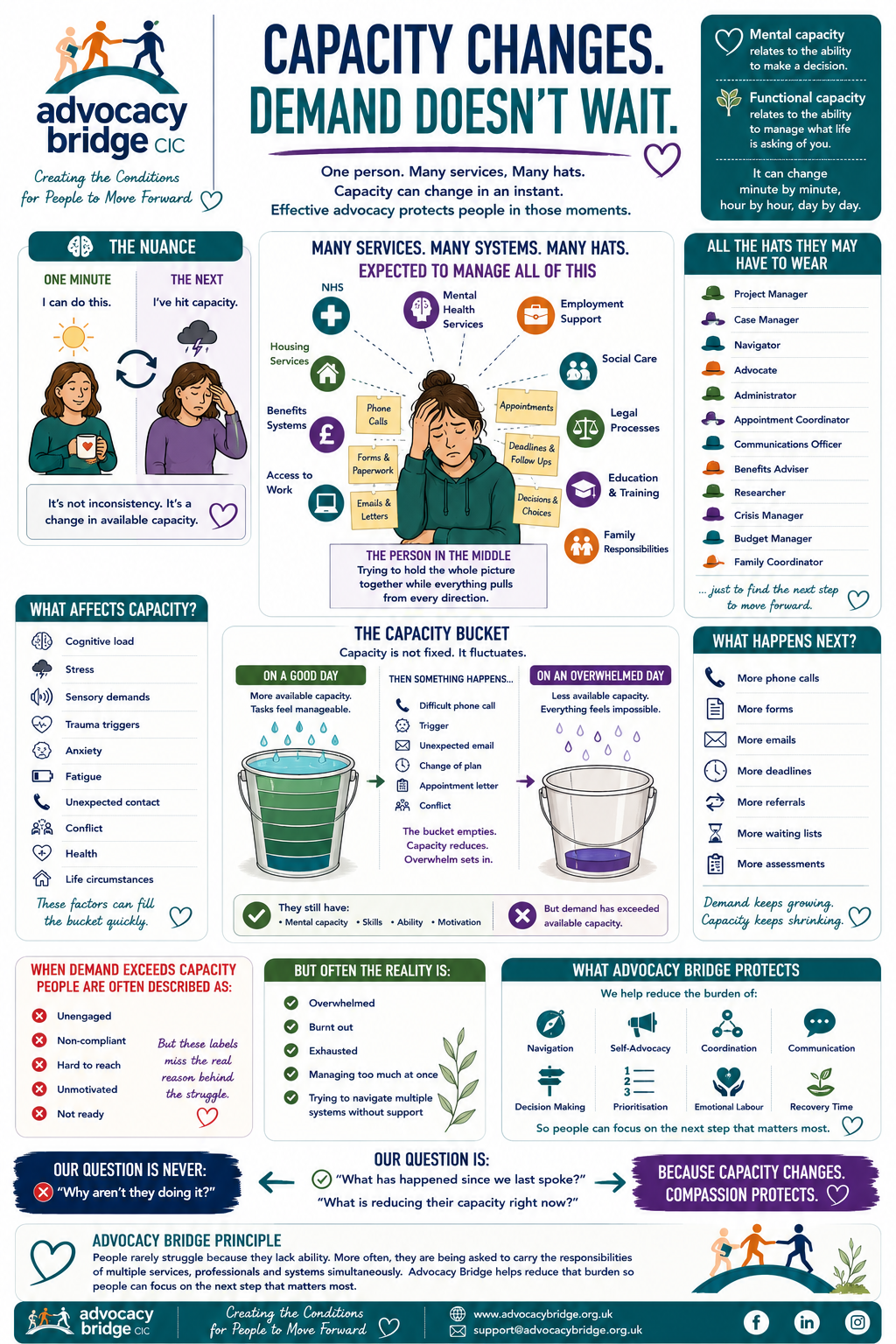
Someone may appear to be coping while struggling with overwhelm, communication, changing capacity or several interconnected challenges at once.
While individual services often focus on one area, we step back and look at the whole picture — what's happening, what's getting in the way and what support might help.
By helping individuals and professionals work from a shared understanding, we can reduce barriers, improve communication and help turn support into meaningful progress.
Not Sure Where to Start?
You don't need to know exactly what support you need before getting in touch.
Tell us what's happening and together we'll explore your situation, your options and what support might help you move forward.
What Happens Next?
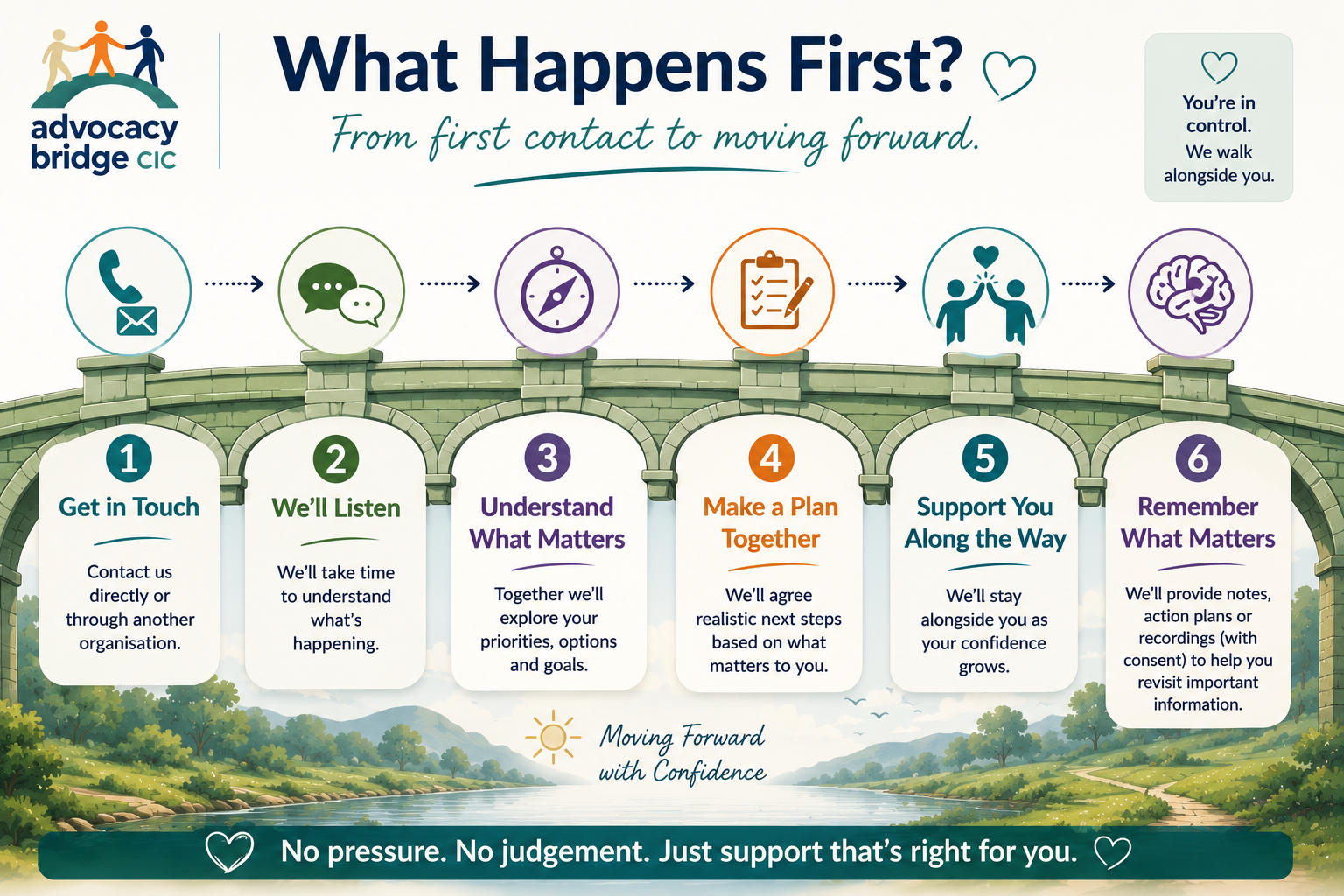
Complete the Initial Enquiry Form.
We'll carefully review your enquiry.
If Advocacy Bridge is the right fit, we'll contact you to arrange an introductory conversation.
Together, we'll explore the most appropriate next steps.
Not sure what to expect?
This short video explains how Advocacy Bridge works and what happens next.
"I wasn't sure what to expect... but I'm very grateful for all the help and tools Michelle is providing me with, to move forward... in a way which takes into account my own needs and to actually put myself first."
Support should reduce barriers, not create more of them.
Advocacy Bridge helps people make sense of themselves, their situations and their options, so they can move forward with greater clarity and confidence.
Presentation Doesn't Always Reflect Capacity
We begin with the person, not the problem.
Instead of asking:
What should this person be able to do?
We ask:
What is this person's capacity today?
From there, we work together to understand:
✔ What's happening
✔ What's working well
✔ What's getting in the way
✔ What support is needed
✔ What a realistic next step looks like
Our aim isn't to replace a person's voice.
It's to create the understanding, confidence and conditions that enable people to participate meaningfully in decisions about their own lives.
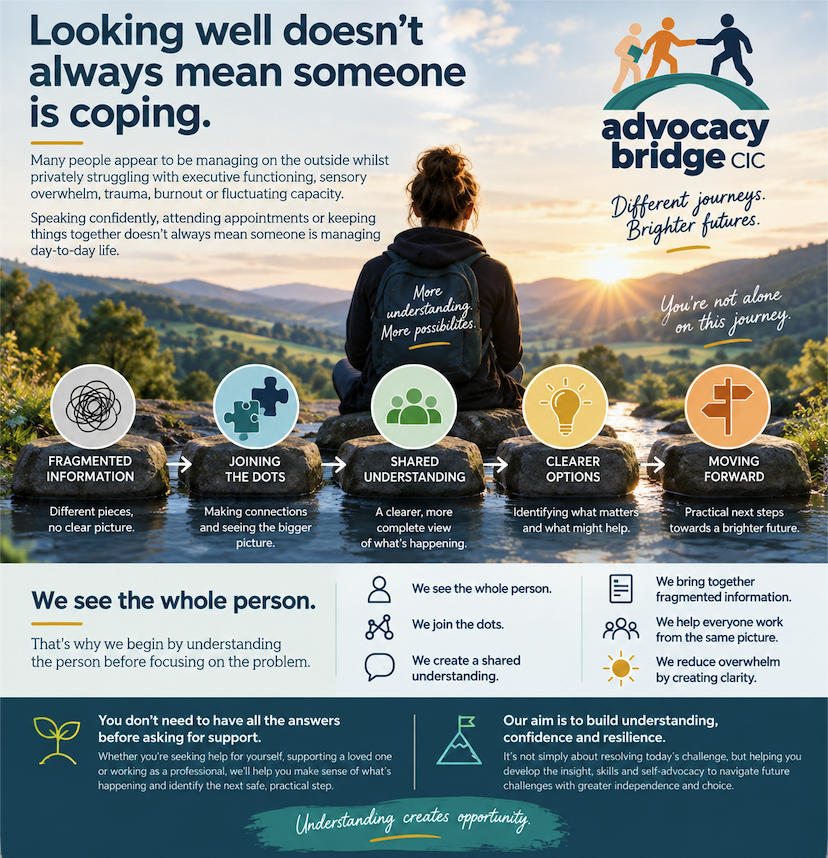
Many people appear to be coping on the outside whilst privately struggling with executive functioning, sensory overwhelm, trauma, burnout or fluctuating capacity. Looking well, speaking confidently or attending appointments doesn't always mean someone is managing day-to-day life.
That's why we begin by understanding the person before focusing on the problem.
We see the whole person.
We join the dots.
We create a shared understanding.
We bring together fragmented information.
We help everyone work from the same picture.
We reduce overwhelm by creating clarity.
We don't just look at one difficulty in isolation. We create a shared understanding of what's happening.
Our aim is to bring together everything you've shared into one clear picture that reflects your experiences, strengths, challenges and circumstances. By seeing how the different pieces fit together, it becomes easier to recognise what's already working well, where the barriers are, what feels most important right now, and where support is most likely to make a meaningful difference.
You don't need to have all the answers before asking for support. Whether you're seeking help for yourself, supporting a loved one or working as a professional, we'll help you make sense of what's happening and identify the next safe, practical step.
Our aim isn't simply to resolve today's challenge. We want to help people develop the understanding, confidence and practical strategies to navigate future challenges with greater independence, self-advocacy and resilience.
Why we join the dots
No one person or service has all the answers.
Most professionals can only work within a specific role, service or area of expertise. As a result, different parts of a person's story often sit with different people.
When support involves health, social care, employment, housing, education, relationships or everyday life, important information can become fragmented or overlooked.
That's where Advocacy Bridge comes in.
We help bring the pieces together, creating a shared understanding of what's happening, what's working, what's getting in the way and what support is most likely to help.
The best outcomes happen when people, professionals and services work together, with the individual at the centre of every conversation, decision and plan.
Whether you're looking for support for yourself, referring someone else or commissioning services for your organisation, we'd be happy to explore how we can work together.
Working that out together is often where we begin.
Support Looks Different for Different People
There is no set formula.
Support is shaped around your needs, goals, circumstances and what matters most to you.
For some people, support may involve a single conversation to help them understand their situation, explore their options and decide on next steps.
For others, it may involve support over weeks or months while navigating health, disability, neurodivergence, workplace challenges, assessments, services, family circumstances or significant life changes.
Whatever the situation, our role is to help people make sense of what's happening, understand what matters most, explore their options and move forward with greater confidence.
Our aim is not to create dependency, but to help people develop the understanding, confidence and practical strategies needed to advocate for themselves and participate more meaningfully in decisions about their lives.
What Happens After You Get In Touch?
We Welcome New Enquiries Throughout the Year
There is no waiting list for initial enquiries.
The start date for ongoing support will depend on current capacity, the type of support required and individual circumstances.
Some people are ready to begin straight away. Others need more time to begin. Some find it helpful to take time to reflect, gather information and consider their options before deciding what support feels right.
You don't need to have everything figured out before getting in touch. Working that out together is often where we begin.
Step 1 – Complete Our Enquiry Form
The enquiry form helps us begin to understand what's happening and who is already alongside you and whether Advocacy Bridge may be able to help.
You don't need to have all the answers. Simply tell us as much as you can about your situation, what's challenging you and what support you're looking for.
This helps us prepare for our first conversation and identify any areas we may need to explore further.
Step 2 – Free Introductory Conversation
Once we've reviewed your enquiry, we'll arrange a free introductory conversation.
This is an opportunity to get to know each other, explore your situation in more detail, answer any questions and consider what support might be most helpful.
During the conversation we may:
Explore what's happening and what feels most important right now
Clarify information from your enquiry
Discuss your goals, priorities and concerns
Explain how Advocacy Bridge works
Consider possible next steps
Step 3 – Finding the Right Way Forward
Some situations are straightforward and it may quickly become clear what support would be most helpful.
Others are more complex and may require further exploration before we can confidently recommend a way forward.
Where appropriate, we may ask additional questions, gather further information or suggest a short period of discovery before agreeing ongoing support.
Complete our Initial Enquiry & Support Request Form.
You don't need to know exactly what support you need before getting in touch.
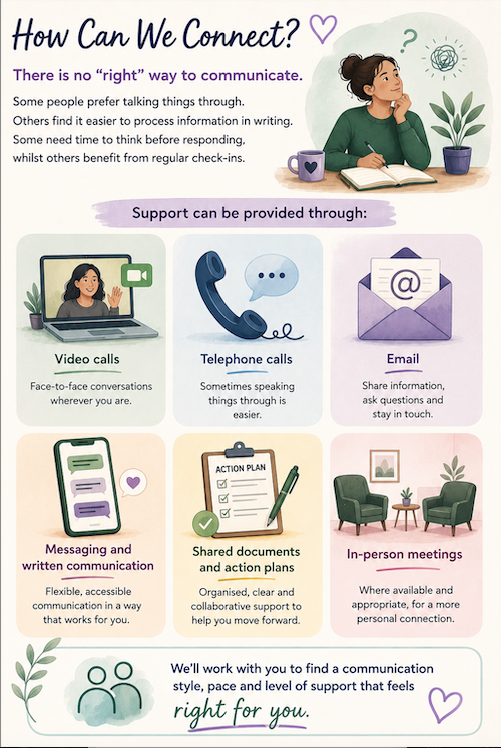
The form helps us understand your situation, your priorities, any communication or accessibility needs you may have, and what you're hoping will change. We'll carefully review the information before arranging an introductory conversation.
Most people complete the form in around 10–15 minutes.
You don't need to have all the answers. You just need somewhere to start.
Before Support Begins
There is no waiting list for new enquiries, and we aim to respond to all enquiries as quickly as possible.
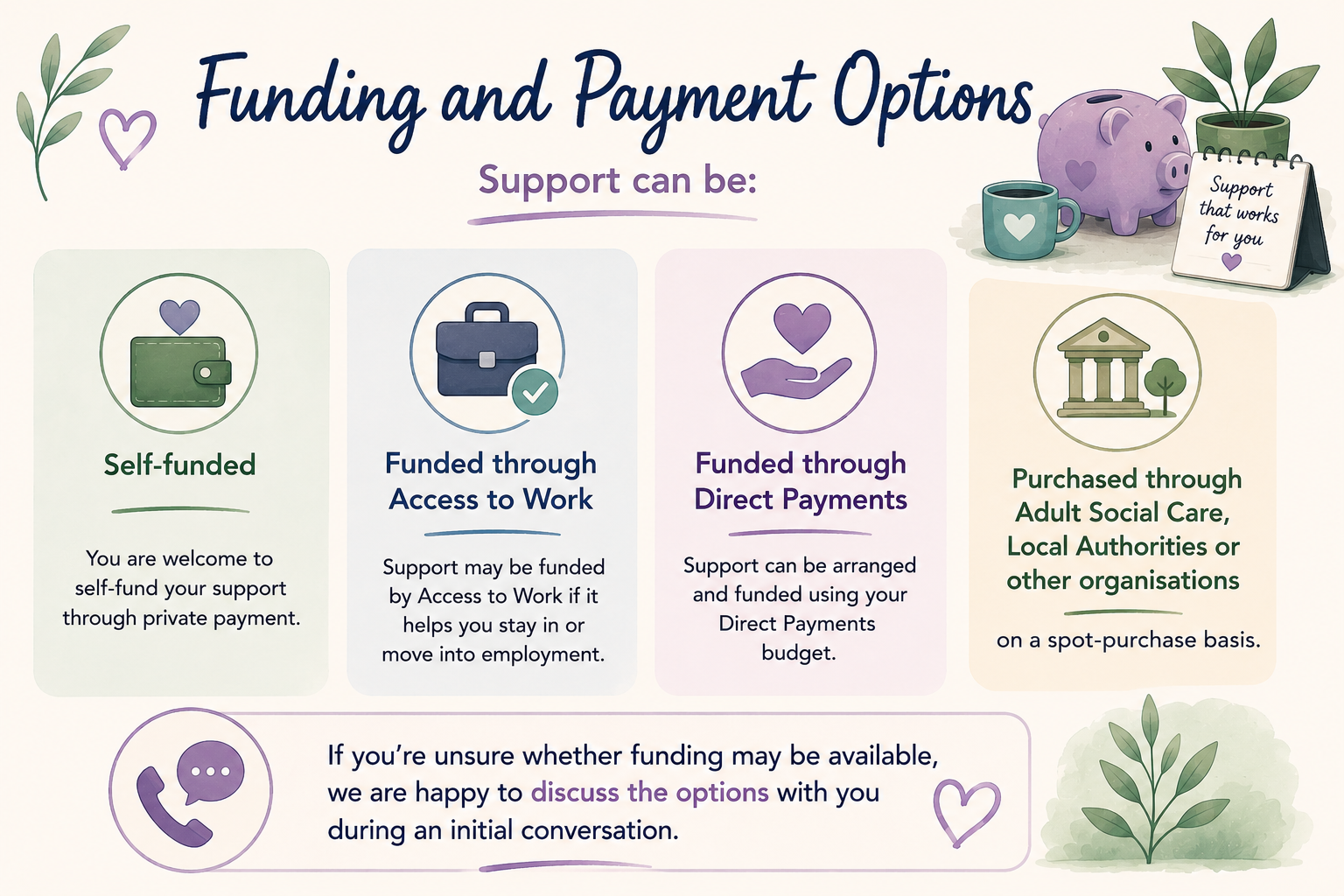
However, support does not always begin immediately. The timing depends on a range of factors, including your circumstances, readiness, availability, funding arrangements and the type of support required.
Our priority is ensuring that support starts at the right time, in the right way, and with the best chance of creating meaningful outcomes.
We'll discuss likely timescales during your introductory conversation and keep you informed throughout the process.
New to Advocacy Bridge?
Please complete our enquiry form first.
Read or Listen to this:
The Instruction Manual You Didn't Know Existed
If you've spent years wondering why life seems harder than it should, why you're constantly exhausted, overwhelmed or struggling to meet expectations despite trying your best, this article may help you make sense of your experiences.
If everything feels too much right now, you might find comfort in the Permission to Pause series — a collection of short reflections designed to help you slow down, reconnect with yourself, and take the next step without pressure.
Permission to Pause: Introduction – Permission To Be
Help Us Improve
Advocacy Bridge is continually evolving through the experiences, insights and feedback of the people who use it.
If you've spotted something we've missed, have an idea that could improve accessibility, communication or understanding, or would simply like to share your experience, we'd love to hear from you.
Our aim is for any potential clients to understand how we work before they agree to work with us, including where and how we can adapt our approach to meet each person's individual needs. This helps us to realistically and accurately set expectations rather than people having to discover our processes and boundaries as they go along
Every suggestion helps us create a service that better supports people to feel heard, understood and able to move forward.